TL;DR: Digital Payment Terminal Board for Restaurant Ordering
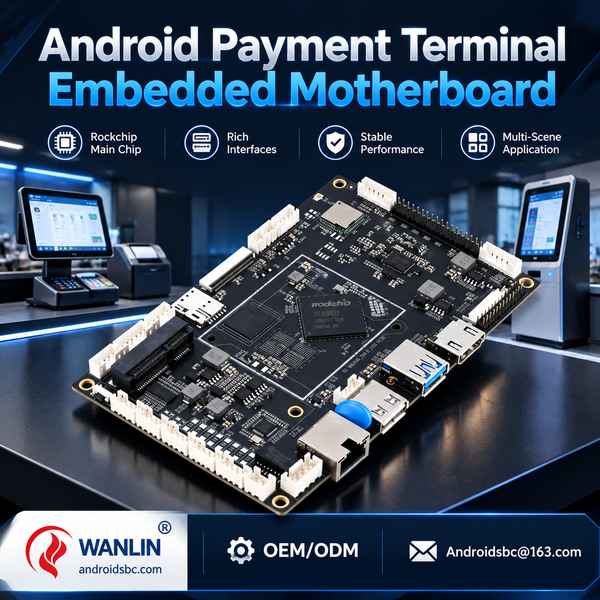
AndroidSBC field deployment report from active smart payment terminal projects serving international market, Switzerland. The WF-SPT-10 smart payment terminal Android motherboard covers the octa-core Android 13 hospitality payment terminal build and eleven sister configurations in the WF-SPT series, spanning the T527 octa-core ARM Cortex-A55 1.8GHz SoC with the ARM Mali-G57 MC1 GPU, 6-inch 1080x1920 MIPI DSI capacitive touch panel, and Android 13 with AOSP baseline and optional GMS firmware support. AndroidSBC, the export arm of Wanlin Manufacturing Group, ships the WF-SPT family from the Longgang source factory in Shenzhen to international market and Switzerland importers who build countertop payment terminals, self-service kiosks, unattended vending and locker machines, transit ticketing gates and outdoor charging pillars.
About AndroidSBC and the Smart Payment Terminal Android Motherboard Family
Wanlin Manufacturing Group runs the smart payment terminal board programme out of Longgang in Shenzhen, where the twelve WF-SPT configurations are assembled, burned in and packed with their compliance documents. For international market and Switzerland importers the practical result is a single bill of materials per production lot and one qualification file per configuration. AndroidSBC holds a fixed bill of materials per production lot, which is the part international market buyers care about most: the board that passed qualification is the board that arrives in volume, twelve months later, on the same peripheral contract.
WF-SPT-10 Technical Specifications
| Parameter | AndroidSBC WF-SPT-10 (octa-core Android 13 hospitality payment terminal build) | Industry Average |
|---|---|---|
| Processor | T527 octa-core ARM Cortex-A55 1.8GHz SoC | Older dual-core or quad-core Cortex-A7 SoC |
| Process node | 12nm | Older 40nm process |
| GPU | Mali-G57 MC1 | Older Mali-400 or basic 2D GPU |
| Memory | 4GB LPDDR4X | DDR3 512MB or 1GB on competing boards |
| Storage | 64GB eMMC plus TF card up to 256GB | NAND flash 4GB or 8GB on competing boards |
| Display and touch | 6-inch 1080x1920 MIPI DSI capacitive touch panel with 10-point capacitive touch with glove and wet-finger support | 4.3-inch 480x800 panel with resistive touch |
| Payment and capture | NFC contactless, IC card, magnetic stripe and signature capture | Camera-only QR capture with no scan engine |
| Printer and peripherals | 80mm thermal printer header with 150mm per second output | No printer control header on competing boards |
| Wireless and positioning | 4G LTE Cat 4 modem plus dual-band WiFi and Bluetooth 5.0 | Single-band 2.4G WiFi 802.11n with no modem |
| Interfaces | 1 USB Type-C host and OTG, 1 USB host, 1 RS232, 1 MIPI CSI, 6 GPIO, 1 SIM slot, 1 thermal printer header | One USB port and no RS232 |
| Operating system | Android 13 with AOSP baseline and optional GMS | Android 9 or Android 10 on competing boards |
| Power and reliability | 12V DC input with 5V/3A peripheral rail, dual-cell RTC and watchdog, -10C to 55C operating ambient | No battery management and no watchdog |
All parameters in the table above are measured at 25C ambient. The AndroidSBC WF-SPT-10 (octa-core Android 13 hospitality payment terminal build) holds the touch panel, the thermal printer, the reader and the scan engine together while running the 72-hour burn-in loop, a configuration that competing single-platform boards rarely document at the top of the temperature window. For Switzerland importers sourcing the WF-SPT family, the WF-SPT-10-A variant is the typical configuration for the hotel front desk and resort reception counters use case, in a payment terminal footprint with a sustained weekly capacity of 5000 pcs/wk.
Challenges in Sourcing Smart Payment Terminal Android Motherboards for Switzerland Buyers
The hidden cost in Switzerland rollouts is the integration labour, not the silicon. A board that arrives with a validated printer profile, a documented scan mapping and an SDK that matches the shipped image removes weeks from a international market project plan.
Certification is not a one-time event in Switzerland. When the acquiring partner updates a kernel version or a contactless limit, the international market integrator needs a board supplier who can reissue the file rather than renegotiate the design. For the international market buyer the test is simple - order 126400 boards as a sample lot, run them against the printer, the reader and the scan engine the project actually uses, and check whether the delivery file matches the pallet. AndroidSBC ships 126400 boards on the Hamburg - Zurich rail lane with the paperwork already attached.
Competitive Comparison: WF-SPT-10 vs Competing Smart Payment Terminal Motherboards
This is the comparison AndroidSBC runs with Switzerland acquiring partners during qualification: what the board documents, what the board validates, and what the board can still do twelve months after the first pallet lands in international market.
- vs consumer tablet boards: the WF-SPT family carries a printer control header, a reader antenna reference design and a scan engine UART mapping, none of which exist on a tablet derivative board.
- vs single-configuration boards: twelve configurations share one peripheral contract, so a international market buyer can move from a countertop lane to an unattended kiosk without re-qualifying the printer or the reader.
- vs boards without a firmware plan: signed images, staged OTA groups with rollback and a published maintenance window come standard, where competing boards ship an image and leave the Switzerland integrator to manage it.
- vs re-spun designs: the bill of materials is frozen per production lot for the length of the agreement, so the board that passed qualification in international market is the board that ships in volume.
Global Cashless Payment, Smart Terminal and Self-Service Checkout Market Trends
AndroidSBC reads the Switzerland market as a documentation market: growth is real, but the programmes go to the supplier whose file clears the acquiring partner first, which is why the octa-core Android 13 hospitality payment terminal build ships with its compliance set rather than after it.
- Countertop tier: WF-SPT-02 covers contactless, IC card, QR and receipt printing in one board, which is the configuration most staffed lanes standardise on.
- Unattended tier: WF-SPT-08 pairs the modem with the printer header and the watchdog for vending, lockers and kiosks where nobody is there to reboot the terminal.
- Flagship tier: WF-SPT-04 adds the larger memory and storage bundle, the customer-facing screen option and the wider temperature window that outdoor and high-throughput formats require.
The Switzerland demand curve rewards the vendor who can hold a configuration. AndroidSBC treats a frozen bill of materials as the product feature that matters most to a international market integrator with an estate to maintain.
WF-SPT-10 Application Scenarios
The WF-SPT-10 octa-core Android 13 hospitality payment terminal build sits inside a twelve-configuration WF-SPT Android motherboard family from AndroidSBC, a Wanlin Manufacturing Group export brand. The WF-SPT-10-A configuration is the typical build for the hotel front desk and resort reception counters use case, with printer current profile, scan engine mapping and staged OTA management bundled.
- Convenience and grocery counters: the WF-SPT-12 takes contactless, IC card and QR at the till and prints the receipt in one pass.
- Restaurant and quick-service counters: the WF-SPT-04 runs order entry, payment and kitchen ticket printing on the same board.
- Unattended vending and lockers: the WF-SPT-03 pairs the modem with the printer header and the watchdog for sites with no staff present.
- EV charging and fuel forecourts: the WF-SPT-09 holds the wide input range and the sunlight readable panel through a full outdoor season.
- Transit gates and event entry: the WF-SPT-04 takes contactless payment and prints the entry ticket without a fixed counter.
- Self-checkout lanes: one board drives the main panel, the scanner and the receipt printer, with the customer screen option where the format needs it.
- Hotel and resort reception: card pre-authorisation, signature capture and folio printing on a board that also runs the restaurant terminal.
- Hospital and clinic payment desks: card, QR and insurance capture on a locked-down build with staged OTA and an audit trail.
- Government and municipal counters: tax, permit and fee payment on a configuration held for the length of the agreement.
Partnership Models for international market Buyers
Three commercial structures cover almost every Switzerland programme AndroidSBC runs, from a distributor buying against a price list to a brand shipping its own label.
- Distribution track: the partner buys the WF-SPT board against a published price list, keeps its own stock, and AndroidSBC supplies the printer profile, the scan mapping and the compliance documents with each lot.
- Integration track: the partner takes the board plus firmware customisation, receipt and language localisation and peripheral validation support, with a joint qualification run at the Longgang factory.
- Private-label track: the WF-SPT board ships under the partner brand with customised boot logo, packaging, enclosure and documentation, on a fixed bill of materials held for the length of the agreement.
Every track ends the same way in Switzerland: the board arrives with its test report, its certificate set and its signed firmware image, whether or not it carries the partner brand in international market.
Frequently Asked Questions
Does the smart payment terminal board family support an octa-core 13 hospitality payment terminal build?
Answer: Yes. The octa-core 13 hospitality payment terminal build is a stock configuration on the smart payment terminal board family from AndroidSBC. All twelve configurations are validated against the same Android build and the same peripheral contract before shipment to Switzerland.
Which configurations are available in the WF-SPT family for Switzerland buyers?
Answer: The family spans T527 plus eleven configurations covering countertop, unattended, outdoor, hospitality and multimedia formats, all documented in one delivery file for international market.
Can one smart payment terminal board drive a touch panel, a thermal printer and a scan engine at once?
Answer: Yes. The board is specified for concurrent panel, printer and scan operation, with the peripheral contract documented so a international market integrator can swap mechanisms without a board change.
What payment scheme certification support does AndroidSBC provide for Switzerland?
Answer: AndroidSBC ships the CE / FCC / RoHS set plus OFCOM CH conformity with every lot, and supports CE marking with the OFCOM radio interface notification testing for the Switzerland configuration through the qualification run at the factory.
What is the minimum order quantity and the sample lead time for Switzerland?
Answer: AndroidSBC quotes samples from one unit with a 1-3 day lead time, holds the configuration for the length of the agreement, and publishes volume tiers from 500 boards for Switzerland programmes.
Is custom ROM, boot logo or pre-installed app development available?
Answer: Yes. Custom ROM, boot logo and pre-install work is scoped as an engineering item and delivered with the board, so the Switzerland integrator receives a terminal that boots into its own application.
How are firmware updates delivered to a Switzerland device estate after deployment?
Answer: The firmware window is published with the configuration: signed images, staged groups, rollback and a maintenance schedule, all documented for the Switzerland operations team.
What shipping terms does AndroidSBC support for Switzerland orders?
Answer: Shipments to Switzerland clear through Port of Hamburg on a weekly lane, with the packing list keyed to the configuration code and the certificate set inside the same carton.
Contact AndroidSBC: Start Your WF-SPT-10 Sourcing Conversation
Partners in international market can start with a single sample configuration or with a full estate specification - both routes end at the same production slot and the same compliance file.
- Email: Androidsbc@163.com
- Export service hotline: +8613261677119
- Website: https://www.androidsbc.com
- Source factory address: Wanlin Group, Building B, Building 1, Beisida Medical Device Building, 28 Nantong Avenue, Baolong Community, Baolong Sub-district, Longgang District, Shenzhen, Guangdong, China
The Longgang source factory holds capacity at 5000 boards per week for Switzerland programmes. international market partners get a frozen bill of materials, a published price list and a compliance file matched to every lot.